

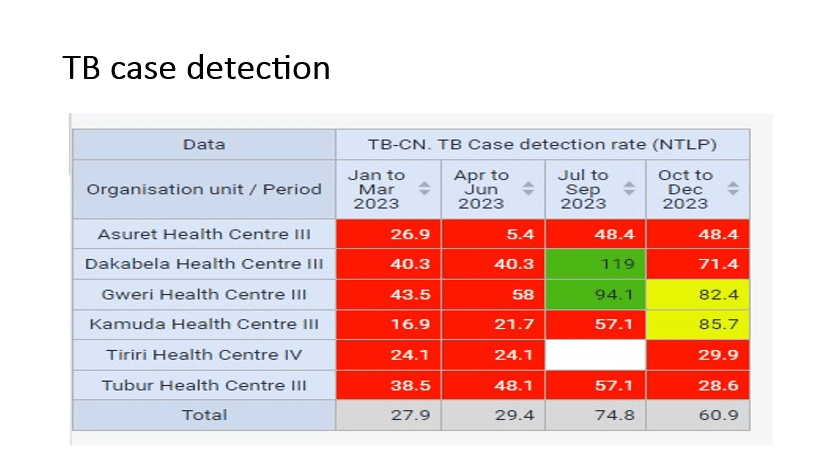
Kuboresha-Africa through her KAL Network and working closely with the National TB and Leprosy Division works toward achieving the Goal and objectives of the National TB and Leprosy Division.The focus on Soroti City is a result of assessing the national TB burden. TB/HIV co-infection is still a burden in Teso. Teso is seeing a decrease in case detection which can be attributed to missed opportunities inadequate health-seeking behaviours and a lack of public awareness. The AIC report 2024 highlights men’s poor health seeking behaviour as a major contributor to lower treatment rates than women. Statistics paint a concerning picture of TB prevalence across demographics, with men accounting for 56% of cases, followed by women at 33% and children under the age of five at 11%. TB case detection at the targeted health facilities is still way behind National targets. At Asuret HCIII -October to December 2023 case detection rate was at 48.4% and at Kamuda HCIII October to December 2023 was at 85.7% all indicating a need for more awareness on TB.

It is against this epidemiological background that Kuboresha is engaging the Soroti City KAL Network to conduct TB and TB/HIV awareness sessions to improve the case detection rate of the city. Kuboresha is replicating a similar 6 months project CRATHA-22 which was implemented in Mukono Municipality by Kuboresha-Africa as a Sub -Sub Recipient of Global Fund NFM 3 grant from TASO under Uganda Stop TB Partnership as a Sub Recipient. The CRATHA-22 project achieved commendable milestones in 2 quarters. The same approach is being rolled -out in Soroti City as a pilot to see how it will impact on the red in Teso region. The project title is CRATHA-24 and the main implementor is our member CBO OREDA (Obule Rural Empowerment and Development Association) based in Teso Region.

BACKGROUND TO THE PILOT ACTIVITY:
Soroti District and Soroti City are the economically, socially and institutionally hosting entities for the metropolitan Teso in Eastern Uganda. It should be appreciated that the burdens of any health dynamics directly fall onto these areas.
SPECIFIC OBJECTIVES OF THE PILOT:
Identification/establishment of community health structures to respond to TB management, prevention and control challenges, in the facilities of Princess Diana Health Centre IV, Tirir Health Centre IV, Asuret Health Centre III, Kamuda Health Centre III, Eastern Division Health Centre III and Soroti Health Centre III.
Improve on detection and care for people with TB.Promote people-centred integrated service delivery (ISD) for TB; lung health closest to the point of need. Include gender-responsive interventions for people with or affected by TB. Aim for sustainability by engaging with government, Global Fund, and other implementing partners. Engage TB Survivors in the implementation of the pilot as people with lived experience.
DURATION OF THE PILOT:
KAL Network Uganda in partnership with OREDA has planned for a three months’ pilot activity for Soroti City and Soroti District on TB, beginning from June to August 2024. The purpose of this pilot activity is to ascertain the TB burden in these areas so as to inform further decision making, resource mobilization and intervention.

INTERVENTION AND CONTROL CENTERS:
OREDA together with KAL Network team visited Soroti District and Soroti City administration and a number of Health facilities. During the visits, it was conclusively agreed that four facilities be used as Intervention centers, namely: Asuret Health Centre III, Kamuda Health Centre III, Eastern Division Health Centre III and Soroti Health Centre III. It was also agreed that two health facilities be used as Control points and these are: Princes Diana Health Centre IV and Tirir Health Centre IV.


 KUBORESHA-AFRICA LIMITED